Mindfulness for the Rest of Us: No Yoga Mat Required.
Let’s be honest: for many of us, the idea of sitting in a dark room for twenty minutes trying to "empty our minds"
feels less like a spa day and more like a chore. We try, we fail, and then we feel even more stressed than when we
started. Our legs fall asleep, our minds race through grocery lists, and eventually, we give up, concluding that
meditation just "isn't for us."
But here's the secret: mindfulness doesn't require a meditation cushion, an hour of your time, or even a subscrip
-tion to a fancy app. It’s not about escaping your life; it’s about showing up for the small, often overlooked parts of it.
If you hate meditating, you’re not broken; you’re just trying to run a marathon before you’ve learned to walk.
What is Micro-Mindfulness?
Enter Micro-Mindfulness. This isn't about lengthy, formal sessions but about "dropping in" to the present moment
for short bursts—think 15 to 60 seconds—during your normal, everyday routine. It's about integrating awareness
into the existing rhythm of your day, rather than adding another daunting task to your to-do list.
The beauty of micro-mindfulness lies in its accessibility. Our brains, much like our muscles, benefit more from
frequency (doing it often) than duration (doing it once for a long time). Each micro-moment is a tiny rep for your
attention span, slowly building your capacity to stay grounded and focused in a world constantly vying for your
attention.
The "Anchor" Method: Embedding Awareness into Your Day
The easiest way to practice micro-mindfulness is to "anchor" it to existing habits. These are things you already do
automatically, providing natural cues to pause and become present.
- The Red Light Reset: The next time you're stuck at a red light, or waiting for the bus, resist the urge to
immediately grab your phone. Instead, take a moment. Notice your grip on the steering wheel or the texture of
the seat beneath you. Soften your shoulders, unclench your jaw, and take one deep, deliberate breath. This
small pause can shift your entire demeanor.
- The Coffee Ritual: Don't just drink your coffee (or tea, or water). Make it a small ritual. Before that first gulp,
feel the warmth of the mug in your hands. Inhale the aroma deeply. Now, take a small sip, letting the liquid
coat your tongue. Notice its temperature, its bitterness, and its sweetness. Try to do this before you look at a
screen or start your day.
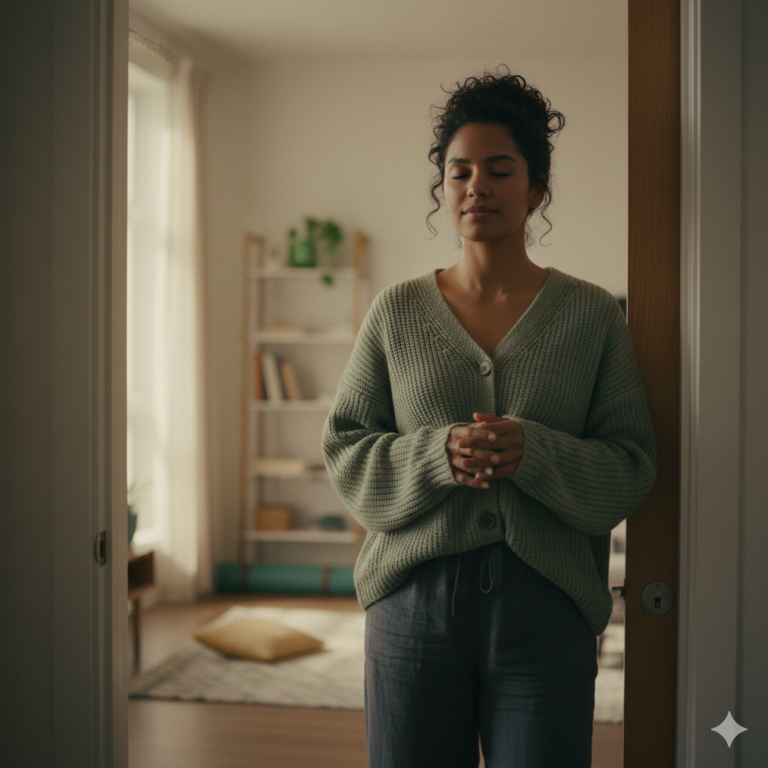
- The "Doorframe" Habit: Every time you walk through a doorframe—entering the room, leaving the office,
getting into your car-let it be a signal. As you cross the threshold, take one full, conscious breath. This simple
act transforms a physical transition into a mental reset, helping you arrive more fully in the next space.
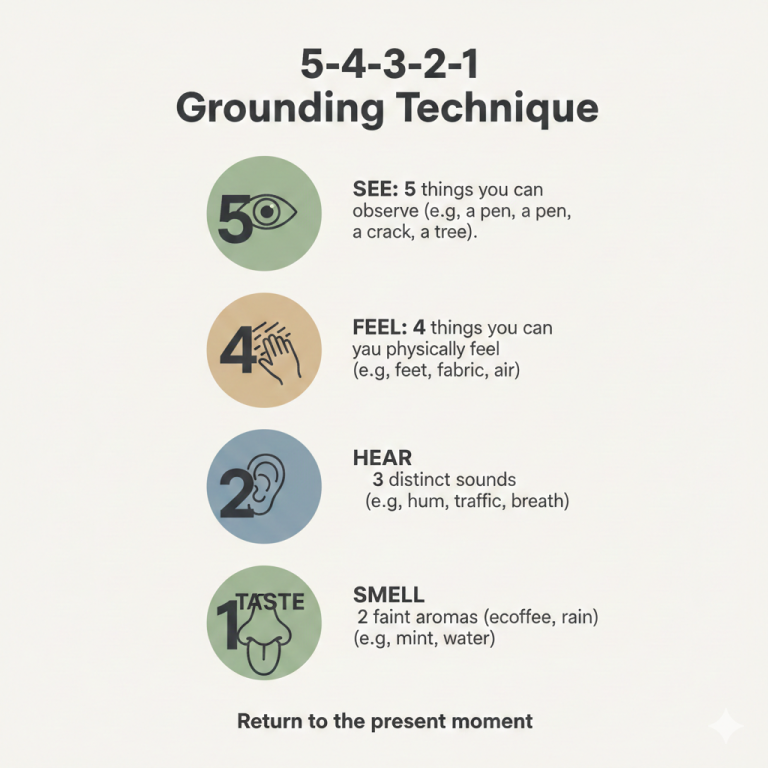
When Anxiety Strikes: The 5-4-3-2-1 Technique
For moments when anxiety feels overwhelming or your mind is racing, here’s a quick sensory grounding technique
that pulls you out of your head and into the present moment. It forces your brain to switch from "thinking" mode to
"sensing" mode:
- 5 things you can see: Look around and name five things you can clearly observe. (e.g., 'the blue pen, the crack in the
wall, my reflection, the tree outside, the dust motes in the light.")
- 4 things you can feel: Notice four things you can physically feel. (e.g., "My feet on the, floor, the fabric of my
shirt, the air on my skin, the weight of my watch.")
- 3 things you can hear: Tune into three distinct sounds. (e.g., "The hum of the computer, distant traffic, my own
breathing.")
- 2 things you can smell: Identify two smells, however faint. (e.g., "My coffee, the scent of the rain outside.")
- 1 thing you can taste: Notice one taste in your mouth, even just the residue from your last drink or food.
(e.g.,Mint, water, nothing distinct.")
This simple exercise can quickly interrupt a spiraling thought pattern and bring you back to the "here and now.
Conclusion: Lowering the Bar, Living More Fully
Micro-mindfulness isn't about becoming a Zen master; it's about becoming more present in your own life. It's
about recognizing that you don't need to carve out huge chunks of time to cultivate peace and awareness.
By lowering the bar and integrating these tiny moments of intentional presence, you'll find that the "big" moments
of your life feel richer, and the stressful moments feel a little less overwhelming.
So, ditch the guilt, forget the formal meditation cushion (unless you love it!), and start sprinkling these micro-
moments throughout your day. Your mind—and your life—will thank you for it.